
Akashi Tomonori, M.A., Kyūshū University, Fukuoka (November 2011 – September 2012)
Dr. Nara Katsuji, Kyōto University, Kyōto (September 2011 – March 2012)
Terazawa Yū, M.A., Kyōto University, Kyōto (September 2011 – March 2012)
Prof. Dr. Yamaguchi Teruomi, Kyūshū University, Fukuoka (August 2012 – January 2013)
Itō Kaori, M.A., Kyūshū University, Fukuoka (October 2012 – March 2014)
Prof. em. Tagai Tokuhei, Tōkyō University, Tōkyō (October 2013 – December 2013)
Prof. Dr. Kido Ei’ichi, Ōsaka University, Ōsaka (March 2019 – March 2020)
Kamioka Mana, M.A., Keiō University, Tōkyō (Summer term 2022)
Prof. Dr. Suganuma Akimasa, Kyūshū Sangyō Daigaku, Fukuoka (April 2026 – March 2027)
Interview Mr. Tagai (November 29, 2017; English translation)
Tokuhei Tagai is Professor Emeritus at the University of Tōkyō and a special research member at the university’s museum; his field of research is mineralogy. This fall, Professor Tagai is visiting Ruhr University Bochum for a month to once again work with sources from the Siebold Archive. In this interview, he talks about his stay, his scientific interest in the collection and its relevance for research.
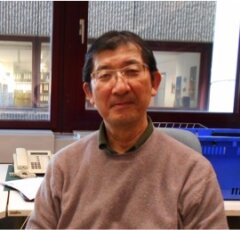
Mr. Tagai, this is not your first time in Bochum. How many times have you visited?
This year is my 6th time in Bochum. On my first visit, I was only here for two days to view the collection; when it became clear how important the sources are, I came to Germany for longer stays, sometimes lasting up to a month.
What have you used the Siebold collection for so far?
The aim of my work with the collection is to complete and publish a work that Siebold had planned at the time, but which was never published: the Mineralogia Japonica.
In a letter to Dr. Temminck, then director of the Museum of Natural History in Leiden, Siebold wrote that he wanted to publish a three-part work on the occasion of his stay in Japan. Based on Carl von Linné’s Systema Naturae (1735), in which he divided nature into the categories of minerals, plants and animals, Siebold planned a publication on the mineralogy, botany and zoology of Japan. The latter two were published under the titles Flora Japonica (1835) and Fauna Japonica (1833), but he was unable to complete the planned Mineralogia Japonica.
With the help of the Siebold Archive, this project can be realized retrospectively; the collection contains, among other things, a manuscript of the Mineralogia, so that the trilogy can be completed.
Which source are you working with this time?
During my current stay, I am working on a manuscript by Heinrich Bürger, who became Siebold’s assistant in Japan in 1825 and later his successor. I was also able to see a corresponding table of contents and corrections written by Siebold himself. Incidentally, Bürger also wrote the aforementioned manuscript of Mineralogia, which he produced on Siebold’s behalf.
How do you finance your research stays in Germany? What funding did you receive?
In this context, the Alexander von Humboldt Foundation’s funding should be mentioned in particular, which covers the costs on site. My research project was also funded by the Japanese Ministry of Education, Science, Sports and Culture and the Toshiba International Foundation.
Have you already published the results of your research?
Yes, I have already been able to publish some of my results, for example in Siebold’s “De Mineralogica Japonica”, a volume published by Harrassowitz in the Acta Sieboldiana series in 2016. However, a part on physics is still pending. I also find Siebold’s determination of the height of Mount Fuji very interesting - I would like to write something about that.
How did you first hear about the Siebold collection in Bochum?
I met Professor Regine Mathias at the International Siebold Conference in 2011 and she told me about the archive at Ruhr University Bochum. At that time, I had already worked with the Siebold mineral collection in Leiden and created a database for it. However, this material was not sufficient to write the Mineralogia Japonica, as there is virtually no written documentation on the specimens.
What do you think are the special features of the Siebold material in Bochum?
Above all, its uniqueness! These sources do not exist anywhere else in the world. In addition, Siebold is very well known in Japan and there is great public interest in his person. In my opinion, this makes the collection particularly relevant.
Which sources in the collection do you find particularly interesting?
For me, Heinrich Bürger’s descriptions are very interesting, but also sources that indicate the relationship between Bürger and Siebold. For example, Siebold made his own handwritten additions when looking through his assistant’s writings.
Apart from the Siebold collection, what do you think of the Ruhr University Bochum?
Overall, I like the campus because it is so new. In addition, the Ruhr University staff seem organized and very reliable to me, so it is a good place to work. Maybe this will not be my last visit.
Dear Mr. Tagai, thank you very much for taking the time for this interview. I hope we can welcome you back to Bochum soon!
For more information about the Siebold Archive (including a Japanese translation of the interview), please visit the collections section.
Interview with Prof. Kido Ei’ichi, DAAD-Visiting Lecturer 2019/20 (English translation)
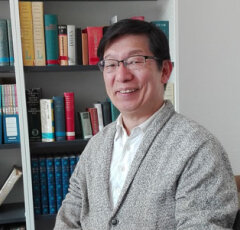
Interview: Marc Paschke, AREA-Doctoral student
Dear Mr. Kido, thank you very much for taking the time to do this short interview. Perhaps you could introduce yourself in a few sentences?
My name is Kido Ei’ichi, my first name is inspired by the first satellite that was launched into space before I was born. I grew up in Tōkyō, live in Kyōto and work at Ōsaka University as an Associate Professor at the School of International Public Policy (Kokusai Kyokyō Seisaku Kenkyūka).
Where did you study? What did you study?
When I was young, I read a letter to the editor in a magazine or newspaper that compared the political situation in Tōkyō - at that time, there was a conflict between Social Democrats and Communists - with the Weimar period in Germany. I decided to learn German and study the history of the country. However, it was only after a three-month stay in the former East Germany in 1979 that I transferred to Hitotsubashi University and began studying more seriously. From 1985 to 1986, I also studied at Karl Marx University in Leipzig, and I have been at Ōsaka University since 1990.
What are your research interests? You are also giving a lecture at our lunch forum in June.
As a political scientist, I am particularly interested in the study of militarism, or the state’s attitude towards enforcing its interests through violence. Funny enough, when I write or give a presentation in German, the topic is Japan, and in Japanese, I deal with the German state - exactly the opposite. Politikwissenschaftler interessiere ich mich insbesondere für die Militarismusforschung bzw. die Haltung des Staates, seine Interessen mit Gewalt durchzusetzen. Lustigerweise, wenn ich auf Deutsch schreibe oder eine Präsentation halte, ist das Thema Japan, und auf Japanisch beschäftige ich mich mit dem deutschen Staat, also genau umgekehrt. Sie sind jetzt über den DAAD als Gastdozent hier.
You are now here as a visiting lecturer through the DAAD. How long will you stay, and is this your first time in Bochum?
That’s correct. I am here in Bochum for one year as a lecturer, but I would actually love to stay longer. It is the first time I have been in Bochum or West Germany for an extended period. Before this, I have been to Germany, especially East Germany, certainly more than 40 times, but usually only for short stays and lectures.
That’s why you speak perfect German. Do you like it at the University of Bochum?
Yes, I must say that I really like it in Bochum, but I can’t decide where I like it the best. Nevertheless, I would be happy to stay longer.
What courses are you offering this semester?
In total, there are three courses: On Tuesday, a seminar on the history and historical revisionism in Japan, on Wednesday, a text reading course where we are currently reading about the Japanese constitution and the much-discussed Article 9, and finally on Friday, a lecture on current topics in Japanese studies.
A very warm thank you for your time, Mr. Kido. We wish you continued enjoyment here in Bochum and look forward to two educational semesters with you! Or perhaps even more?
You can find an interview with Kamioka Mana that appeared in the RUB News here (ger.).
Coming soon.
Copyright © GJ 2026
Last update: May 18, 2026
